Diseño e Implementación de Vehículo Teleoperado con Transmisión Simulada y Force Feedback
Tesis de Grado en Ingeniería en Computación — Universidad Federal de Ceará
- Autor
- Inácio Rodrigues de Matos Galvão
- Director
- Prof. Dr. José Marques Soares
- Codirector
- Ing. Mtr. Artur Rodrigues Rocha Neto
Hipótesis
UDP simple sobre Wi-Fi doméstico, combinado con force feedback calculado desde una IMU embebida, es suficiente para teleoperación responsiva en hardware de bajo costo.
Objetivo
Diseñar, implementar y validar una arquitectura de teleoperación para vehículo a escala 1:5 estilo Fórmula 1, evaluando latencia, pérdida de paquetes, fidelidad del modelo del motor, respuesta háptica, autonomía y comportamiento térmico.
Contexto y motivación
Los sistemas de teleoperación son relevantes en minería, exploración espacial y operaciones militares — donde latencia y retorno háptico determinan la precisión de la tarea. Las soluciones comerciales existentes cuestan más de R$ 50.000 y son complejas. Este trabajo demuestra que arquitectura equivalente es viable en hardware abierto de R$ 1.300.
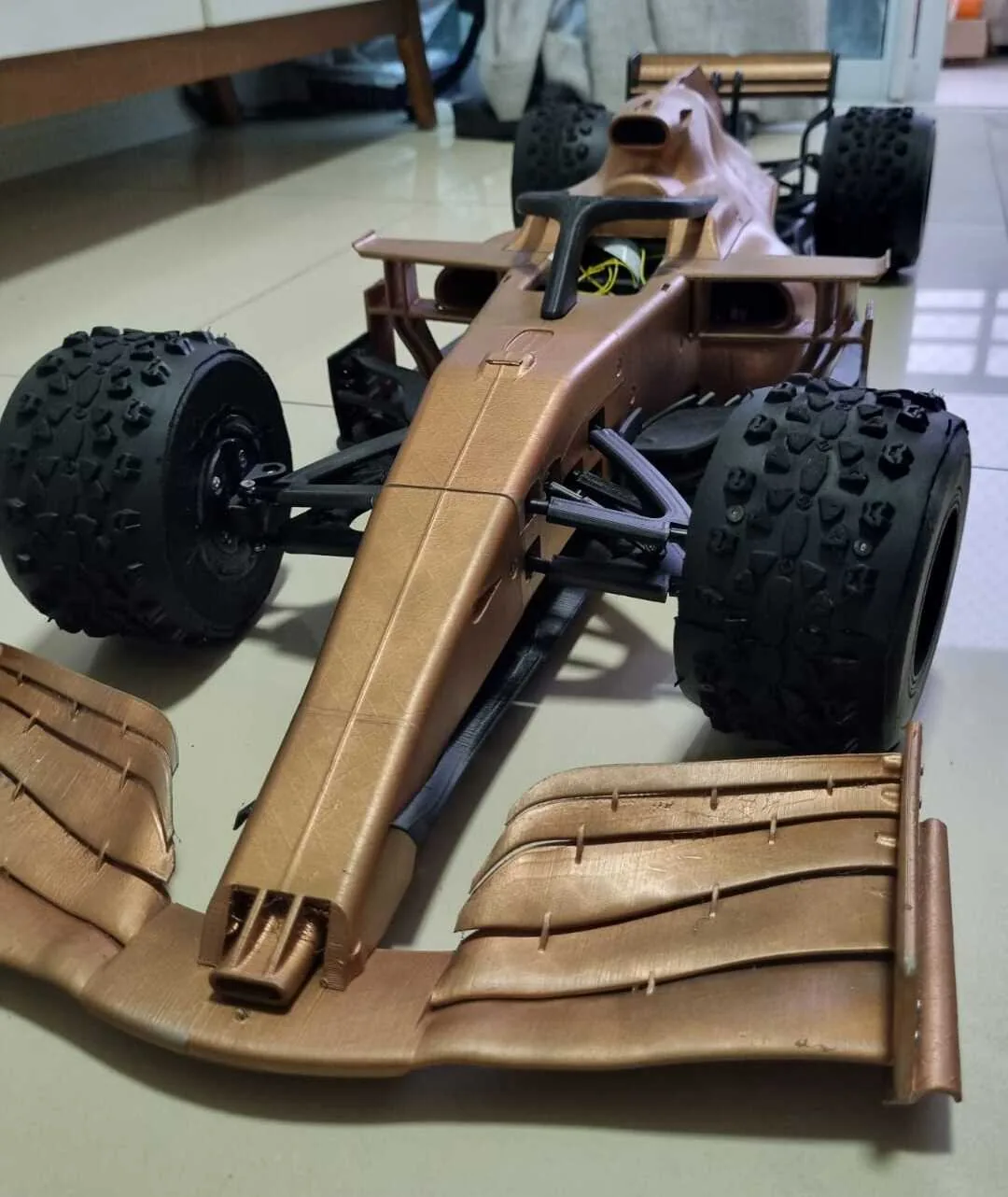
Arquitectura
Tres capas: vehículo embebido (Raspberry Pi 4, cámara, IMU, motor, servos), cliente PC (decodifica video MJPEG, calcula force feedback, muestra telemetría) y simulador Logitech G923. Comunicación vía tres puertos UDP independientes — video, telemetría y comandos — para que frames de video no bloqueen los 100 Hz exigidos por el retorno háptico.
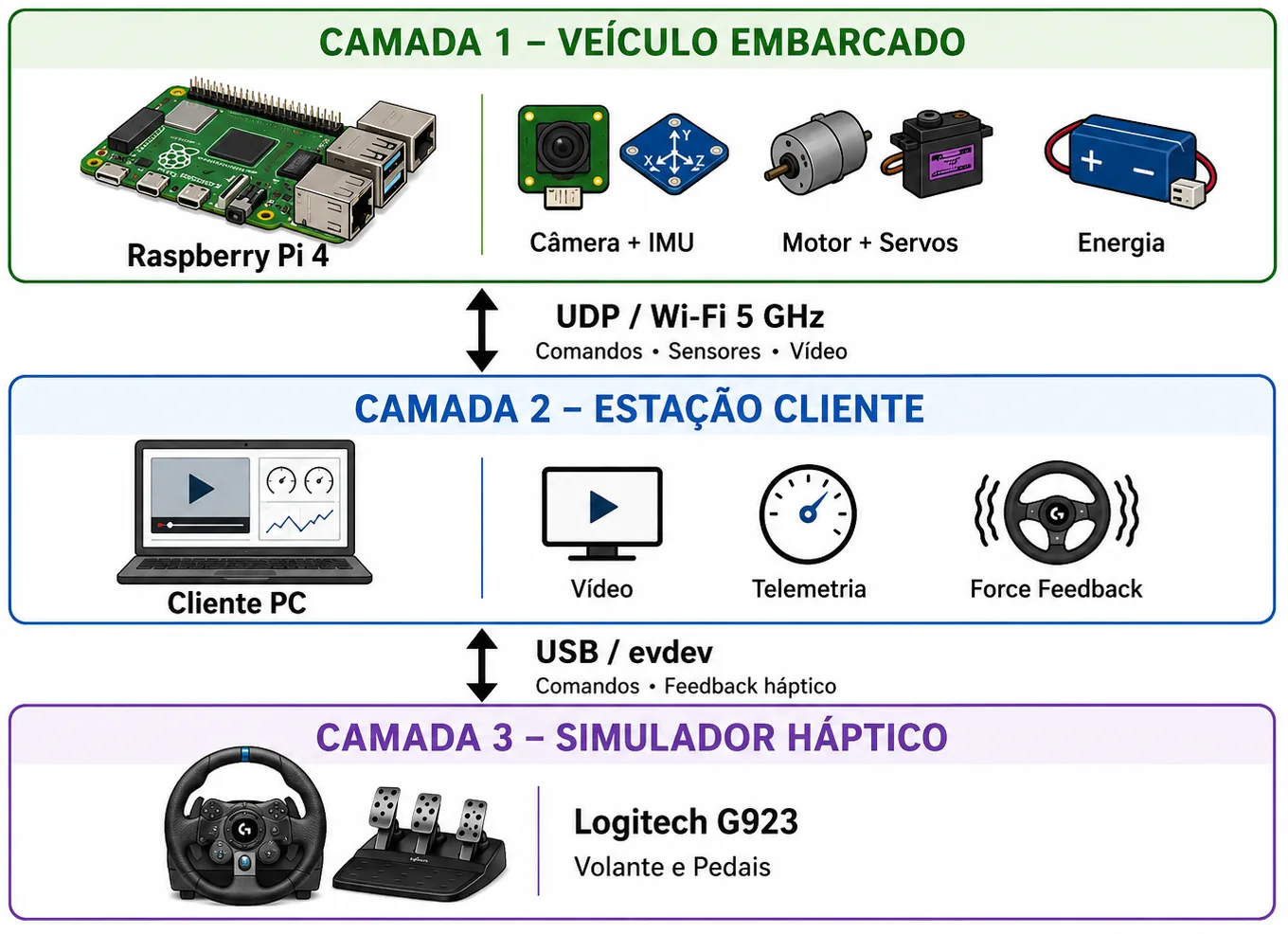
Stack y hardware
Modelo del motor
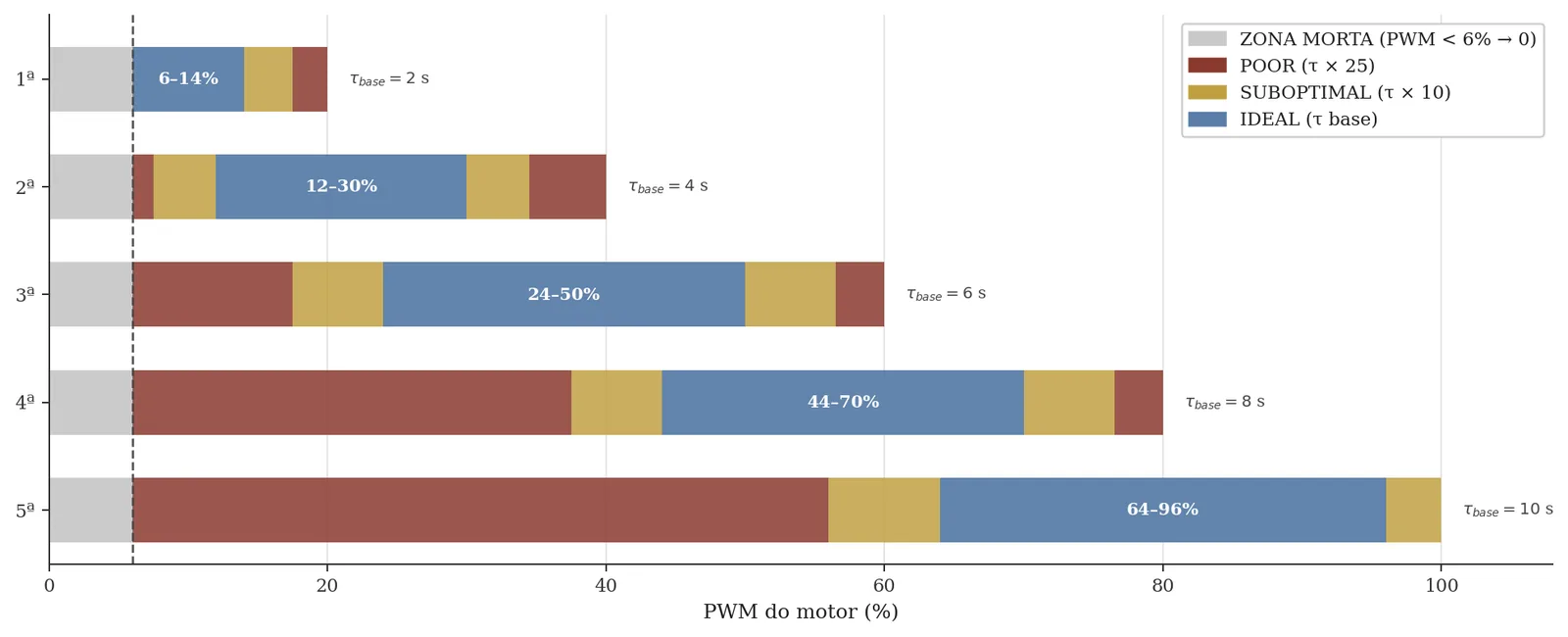
Motor DC 775 con transmisión de cinco marchas modelado como sistema de primer orden G(s) = K / (τ_eff · s + 1), donde τ_eff = τ_base(g) · M_zona. τ_base crece de 2 s (1ª marcha) a 10 s (5ª); M_zona vale 1,0 (IDEAL), 10,0 (SUBÓPTIMA) o 25,0 (POBRE). Operar en marcha equivocada para el rango de RPM penaliza la respuesta, como en una transmisión real.
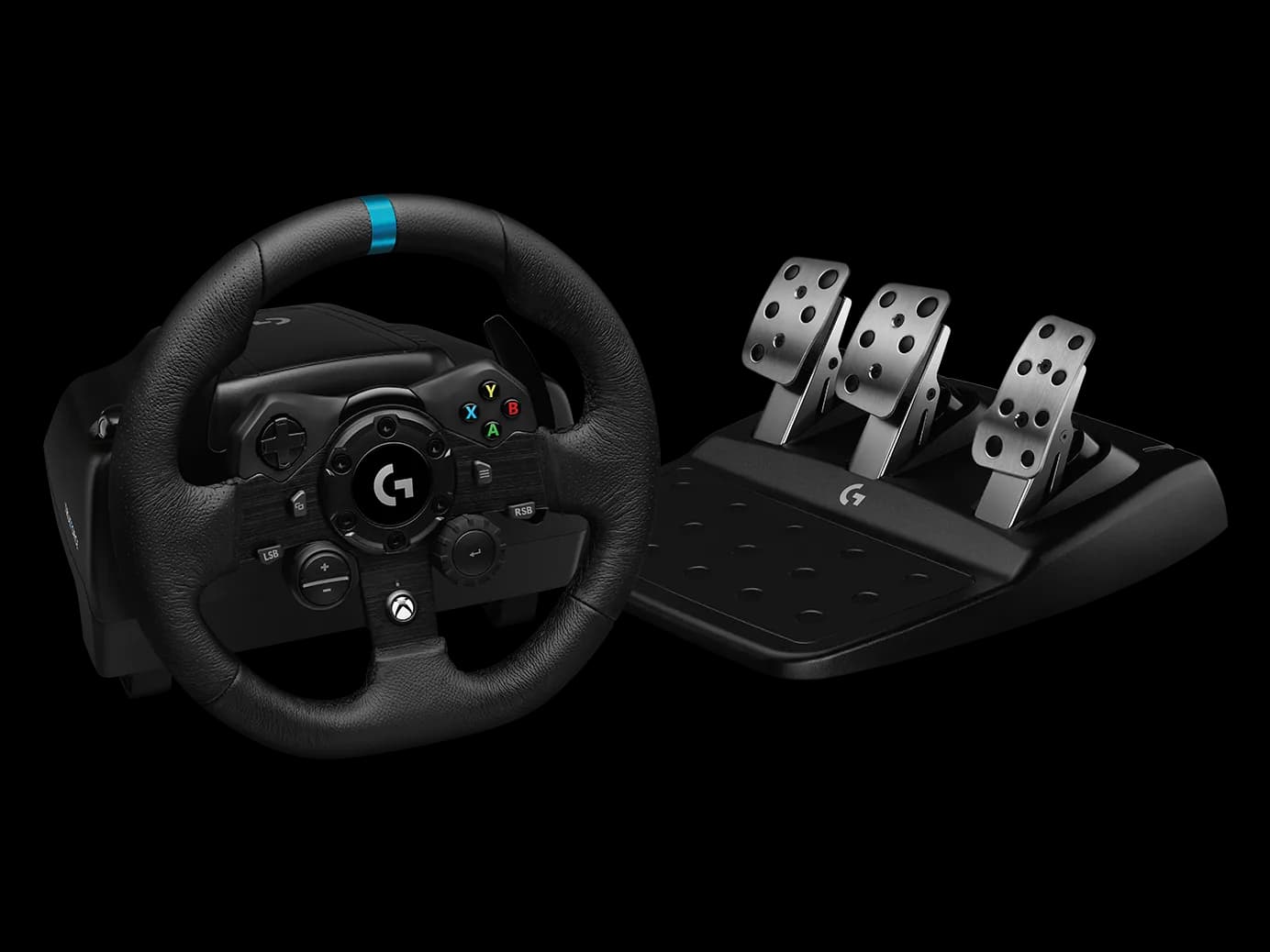
Force feedback (G923)
Siete tipos de efecto en ocho instancias paralelas: condicionales (centrado, amortiguación, fricción, inercia) actualizados a 1 kHz en el firmware del volante, fuerza lateral basada en la G lateral del BMI160 a 100 Hz, topes virtuales en los límites de curso, y vibración de impacto sincronizada con sensores. Caché por efecto redujo el bloqueo de la thread de sensores de 12–60 ms a 0–15 ms por paquete.
Experimentos
13 sesiones experimentales — 9 indoor (ruedas libres, 27±2 °C) y 4 externas en pista de 55,81 m — totalizando ~165 min y ~983 mil muestras agregadas.
Resultados
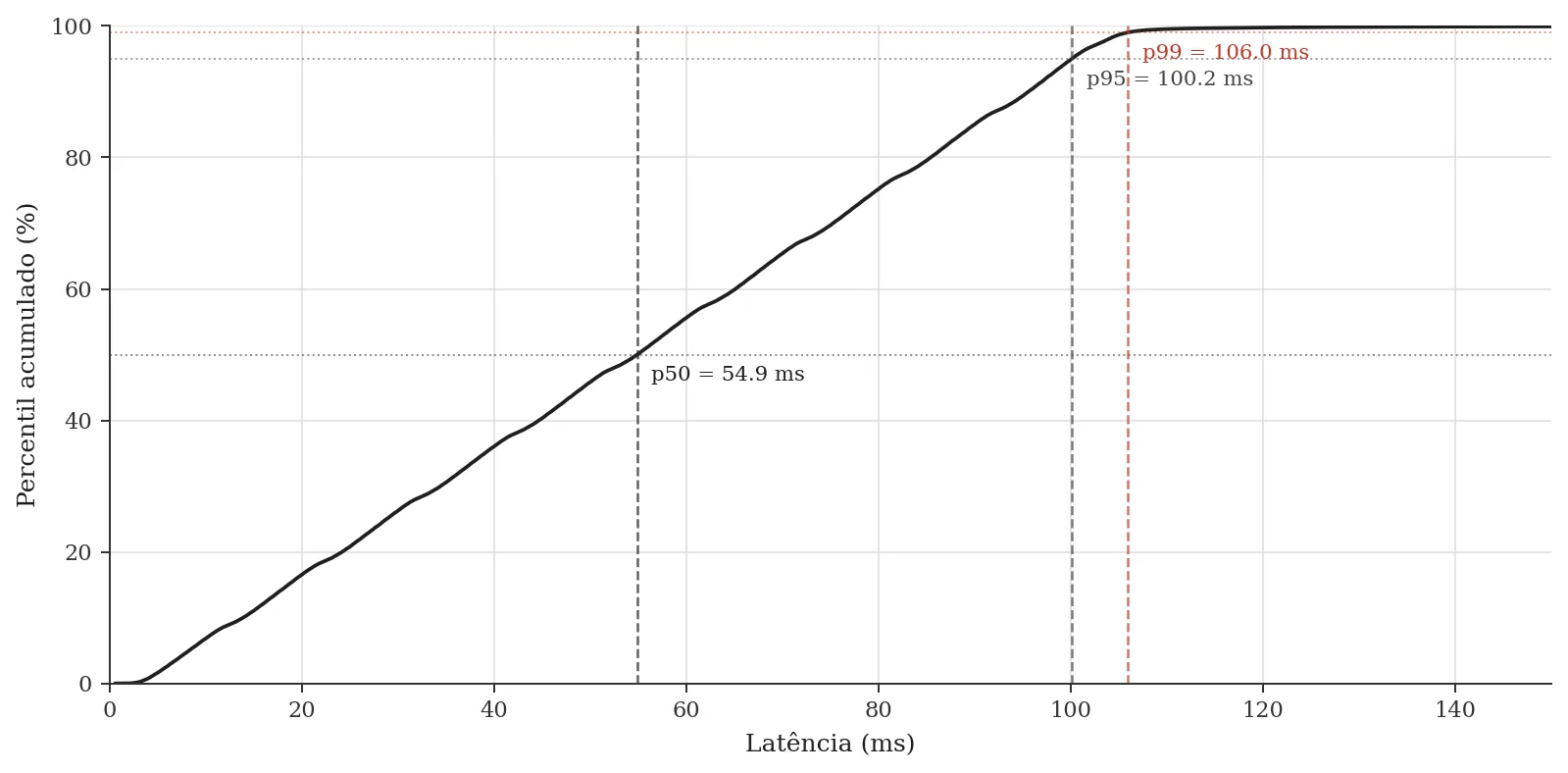
Todas las metas alcanzadas. Latencia extremo a extremo a 1,1× la meta, con cuello de botella en el Wi-Fi compartido — no en el vehículo. Migrar a enlace dedicado reduciría el p50 en un orden de magnitud sin cambios en el código.
Conclusión
UDP simple + modelo de primer orden + force feedback directo entregan teleoperación responsiva en hardware de bajo costo. La limitación principal fue estructural, no electrónica: chasis en PLA y soportes del motor cedieron en pista. El trabajo valida la hipótesis y abre camino para evoluciones con chasis metálico y enlace de red dedicado.
Referencias bibliográficas
53 referencias citadas en la tesis, agrupadas por tipo. Haz clic en cada categoría para expandir.
Libros3
- Gene F. Franklin and J. David Powell and Abbas Emami-Naeini. Sistemas de Controle para Engenharia. Bookman, 2013.
- Rafael C. Gonzalez, Richard E. Woods. Processamento Digital de Imagens. Pearson Prentice Hall, 2009.
- Ruggiero, Márcia A. Gomes and Lopes, Vera Lúcia da Rocha. Cálculo Numérico: Aspectos Teóricos e Computacionais. Makron Books/Pearson, 1996.
Artículos33
- Kumari, Mona and Singh, Maheswari Prasad and Singh, Amit Kumar. A latency sensitive and agile IIoT architecture with optimized edge node selection and task scheduling. Digital Communications and Networks, 2025.
- Ito, Koki and Nakazato, Jin and Fontugne, Romain and Tsukada, Manabu and Hiroshi, Esaki. A multipath redundancy communication framework for enhancing 5G mobile communication quality. Computer Communications, 2025.
- Ajayi, Oluwaseun Kayode and Du, Shengzhi and Nahri, Syeda Nadiah Fatima. A review of haptic technologies for hardware-in-the-loop development. Sensors and Actuators Reports, 2025.
- Khodamipour, Gholamreza and Khorashadizadeh, Saeed and Farshad, Mohsen. Adaptive formation control of leader-follower mobile robots using reinforcement learning and the Fourier series expansion. ISA Transactions, 2023.
- Deng, Zhen and Zhang, Shengzhan and Guo, Yuxin and Jiang, Hongqi and Zheng, Xiaochun and He, Bingwei. Assisted teleoperation control of robotic endoscope with visual feedback for nasotracheal intubation. Robotics and Autonomous Systems, 2024.
- Li, Wenwen and Huang, Fanghao and Chen, Zihao and Chen, Zheng. Automatic-switching-based teleoperation framework for mobile manipulator with asymmetrical mapping and force feedback. Mechatronics, 2024.
- Shukla, Ashish and Ross, Robert and Bhattacharya, Bishakh and Stumpf, Alex. Autonomous water sampling and quality monitoring in remote locations: A novel approach using a remote-controlled boat. HardwareX, 2025.
- Manuel, Nelson Luis and Inanç, Nihat and Lüy, Murat. Control and performance analyses of a DC motor using optimized PIDs and fuzzy logic controller. Results in Control and Optimization, 2023.
- Ji, Qinglei and Jansson, Jakob and Sjöberg, Mikael and Wang, Xi Vincent and Wang, Lihui and Feng, Lei. Design and calibration of 3D printed soft deformation sensors for soft actuator control. Mechatronics, 2023.
- Shaik, Zuber Basha and Peddakrishna, Samineni. Design and implementation of electric vehicle with autonomous motion and steering control system using single board computer and sensors. Results in Engineering, 2025.
- Bobrovsky, A. V. and Drobchenko, A. E. and Zotov, A. V. and Gorokhova, D. A. and Chizhatkina, E. D.. Development of a Universal Module for Connecting Sensors to the CAN-bus for the Formula Student Electric Car. Transportation Research Procedia, 2023.
- Shendge, Akshata and Singh, Rajendra and Ansari, Kashif I.B.H. and Pakhrani, Kishita. Development of an unmanned aerial vehicle for remote live streaming on web dashboard. Materials Today: Proceedings, 2023.
- An, Dohyun and Joo, Hyeontae and Kim, Hwangnam. Enabling low-latency digital twins for large-scale UAV networks using MQTT-based communication framework. ICT Express, 2025.
- Dreger, Felix A. and Rinkenauer, Gerhard. Evaluation of different feedback designs for target guidance in human controlled robotic cranes: A comparison between high and low performance groups. Applied Ergonomics, 2024.
- Santos, Vladimir Sousa and Eras, Juan J. Cabello and Ulloa, Mario J. Cabello. Evaluation of the energy saving potential in electric motors applying a load-based voltage control method. Energy, 2024.
- Rodríguez-Arellano, Jesús Abraham and Miranda-Colorado, Roger and Villafuerte-Segura, Raúl and Aguilar, Luis T.. Experimental observer-based delayed control of wheeled mobile robots. Applied Mathematical Modelling, 2025.
- Vashisht, Ankit and Gandhi, Geeta Chhabra and Kalra, Sumit and Saini, Dinesh Kumar. Hybrid robot navigation: Integrating monocular depth estimation and visual odometry for efficient navigation on low-resource hardware. Computers and Electrical Engineering, 2025.
- Graf, Fabian and Watteyne, Thomas and Villnow, Michael. Monitoring performance metrics in low-power wireless systems. ICT Express, 2024.
- Barón, Miguel and Diez, Luis and Zverev, Mihail and Juárez, José R. and Agüero, Ramón. On the performance of Zenoh in Industrial IoT Scenarios. Ad Hoc Networks, 2025.
- Ayinla, Shehu Lukman and Amosa, Temitope Ibrahim and Ibrahim, Oladimeji and Rahman, Md. Siddikur and Bahashwan, Abdulrahman Abdullah and Mostafa, Mohammad Golam and Yusuf, Abdulrahman Olalekan. Optimal control of DC motor using leader-based Harris Hawks optimization algorithm. Franklin Open, 2024.
- Gökçe, Celal Onur and Ipek, Mahmut Esat and Dayıoğlu, Mehmet and Ünal, Rıdvan. Parameter estimation and speed control of real DC motor with low resolution encoder. Results in Control and Optimization, 2025.
- Chen, Sixun and Noguchi, Noboru. Remote safety system for a robot tractor using a monocular camera and a YOLO-based method. Computers and Electronics in Agriculture, 2023.
- Huo, Faren and Wang, Tai and Fang, Fei and Sun, Cong. The influence of tactile feedback in In-vehicle central control interfaces on driver emotions: A comparative study of touchscreens and physical buttons. International Journal of Industrial Ergonomics, 2024.
- Lu, Qiuyu and Li, June and Yuan, Kai and Liu, Kaipei and Ni, Ming and Luo, Jianbo. UDP-RT: A UDP-based reliable transmission scheme for power WAPS. Computer Networks, 2023.
- Iqbal, Faheem and Gohar, Moneeb and Karamti, Hanen and Karamti, Walid and Koh, Seok-Joo and Choi, Jin-Ghoo. Use of QUIC for AMQP in IoT networks. Computer Networks, 2023.
- Xia, Pengxiang and You, Hengxu and Du, Jing. Visual-haptic feedback for ROV subsea navigation control. Automation in Construction, 2023.
- AL-Dhief, Fahad Taha and Sabri, Naseer and Abdul Latiff, N. M. and Nik Abd. Malik, Nik Noordini and Albader, Musatafa Abbas Abbood and Mohammed, Mazin Abed and AL-Haddad, Rami Noori and Salman, Yasir Dawood and Abd Ghani, Mohd Khanapi and Obaid, Omar Ibrahim. Performance Comparison between TCP. International Journal of Engineering \& Technology, 2018, v.7, n.4.36, p.172--176.
- Bekele, Bereket Endale and Tokarz, Krzysztof and Gebeyehu, Nebiyat Yilikal and Pochopie{\'n. Performance Evaluation of UDP. Electronics, 2024, v.13, n.18, p.3697.
- Yang, Bo and Liu, Chao and Zhang, Lei and Teng, Long and Tian, Jiawei and Xu, Siyuan and Zheng, Wenfeng. Novel Design of Three-Channel Bilateral Teleoperation with Communication Delay Using Wave Variable Compensators. Electronics, 2025, v.14, n.13, p.2595.
- Ye, Yang and Zhou, Tianyu and Zhu, Qi and Vann, William and Du, Jing. Brain functional connectivity under teleoperation latency: a fNIRS. Frontiers in Neuroscience, 2024, v.18, p.1416719.
- Ji, Xunbi A. and Avedisov, Sergei S. and Khan, Mohammad Irfan and Vörös, Illés and Altintas, Onur and Orosz, Gábor. On the effects of latency in teleoperated driving: stability and performance analysis. Vehicle System Dynamics, 2025.
- Chang, Yeong-Hwa and Yang, Cheng-Yuan and Lin, Hung-Wei. Robust Adaptive-Sliding-Mode Control for Teleoperation Systems with Time-Varying Delays and Uncertainties. Robotics, 2024, v.13, n.6, p.89.
- Rafiei, Shirin and Singhal, Chetna and Brunnström, Kjell and Andersson, Jonas and Sjöström, Mårten. Laboratory study on quality of experience and user experience for teleoperation. Quality and User Experience, 2026, v.11, n.1.
Actas de conferencias1
- Heryana, Ana and Krisnandi, Dikdik and Pardede, Hilman F. and Nurkahfi, Galih Nugraha and Dinata, Mochamad Mardi Marta and Rozie, Andri Fachrur and Firmansyah, Rendra Dwi. Realtime Video Latency Reduction for Autonomous Vehicle Teleoperation Using RTMP. 2022 International Conference on Computer, Control, Informatics and Its Applications (IC3INA), 2022.
Tesis de grado2
- Machado, Gustavo Barbosa. Comparação de desempenho computacional de protocolos de comunicação para IoT, 2021, , p.38.
- Noronha Neto, Otávio. Explorando a jogabilidade em um jogo FPS, 2023.
Manuales y datasheets7
- {Infineon Technologies AG. BTS7960B -- High Current PN Half Bridge, 2013.
- {Allegro MicroSystems. ACS758 -- Thermally Enhanced, Fully Integrated, Hall-Effect-Based Linear Current Sensor IC, 2018.
- {Bosch Sensortec. BMI160 -- Small, Low Power Inertial Measurement Unit, 2015.
- {Maxim Integrated. DS18B20 -- Programmable Resolution 1-Wire Digital Thermometer, 2019.
- {Texas Instruments. INA219 -- Zero-Drift, Bidirectional Current/Power Monitor with I2C Interface, 2015.
- {NXP Semiconductors. PCA9685 -- 16-channel, 12-bit PWM Fm+ I2C-bus LED controller, 2015.
- {XLSEMI. XL4015 -- 5A 180KHz 36V Buck DC to DC Converter, 2017.
Otros (web, estándares, normas)7
- {VelocityProjects3D. FV01 -- The Most Advanced 3D Printed RC Formula 1 Car. Printables, 2024.
- {Autodesk. Tinkercad -- From mind to design in minutes. Software de modelagem 3D online, 2024.
- {UltiMaker. UltiMaker Cura -- Trusted by millions of users worldwide. Software fatiador para impressão 3D, 2024.
- {Logitech G. Volante de corrida Sim Logitech G923. Página oficial do produto, 2024.
- {TP-Link. Roteador Mesh Wi-Fi. Página oficial do produto, 2024.
- Belogolovy, Andrey and Dasalukunte, Deepak and Dorrance, Richard and Stupachenko, Evgeny and Zhang, Xue. Low latency communication over commercially available LTE. arXiv preprint arXiv:2209.09794, 2022.
- Black, David Gregory and Tirindelli, Maria and Salcudean, Septimiu and Wein, Wolfgang and Esposito, Marco. Visual-Haptic Model Mediated Teleoperation for Remote Ultrasound. arXiv preprint arXiv:2502.07922, 2025.